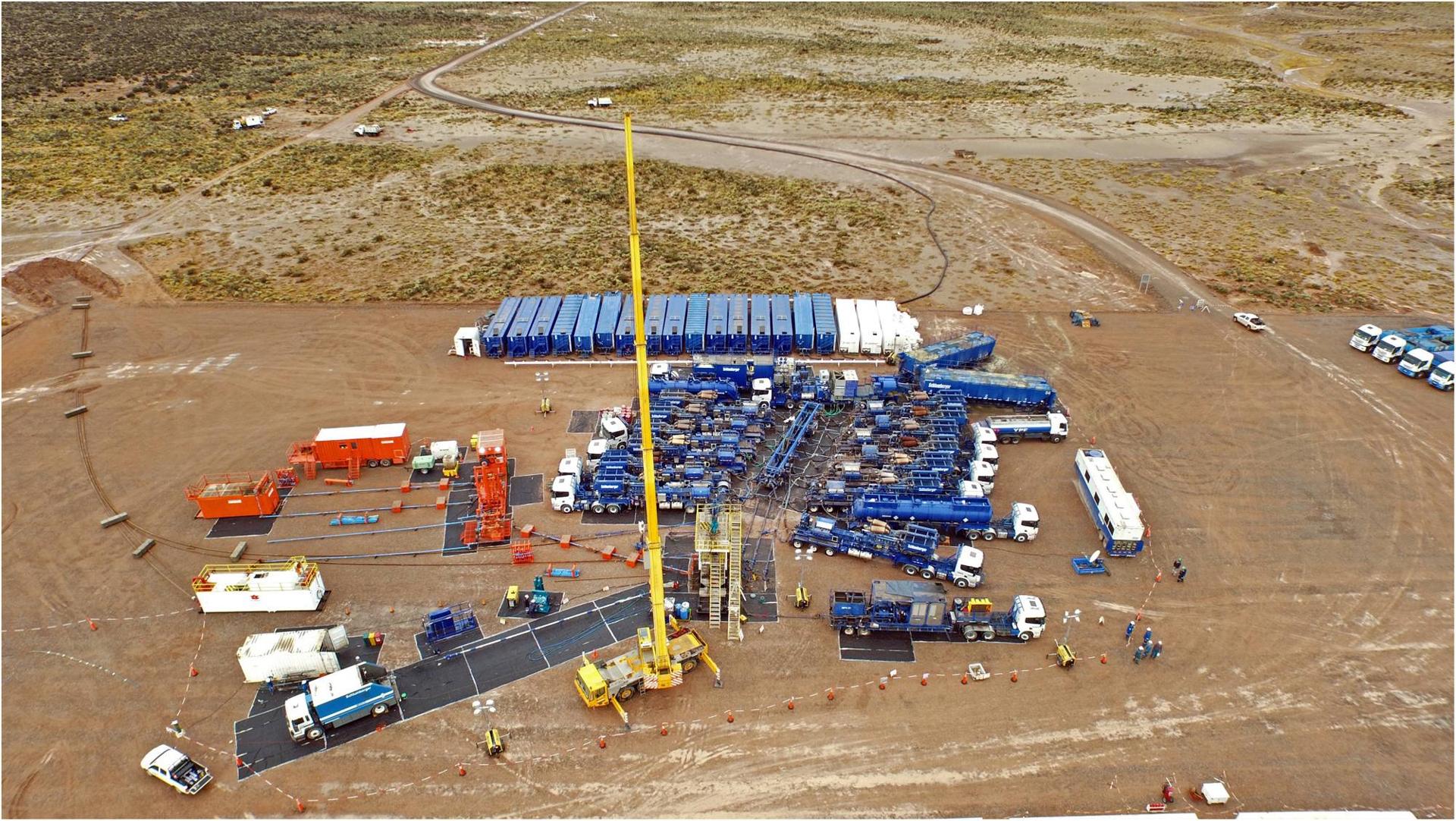
Integrated Field Development & EOR
Full-field development plans that connect subsurface characterisation, completion design and production analysis. Includes deep and sour gas development, LNG supply and enhanced-recovery strategy.
Geomechanics, hydraulic fracturing, stimulation, production, EOR and field-development engineering for the industry's toughest assets: HP/HT, ultra-sour, tight and unconventional. Every engagement is led personally by our technical directors, with 60+ years of combined field experience on four continents.
Most operators hire separate specialists for geomechanics, fracturing, stimulation, reservoir engineering, EOR and field development, and lose the physics that connects them. FracWorkS keeps the whole chain in one team, so every design decision carries through to a production forecast and development plan you can defend to partners and regulators.
Our work has opened plays that resisted development for four decades, including the first successful offshore hydraulic fracture treatment in the UAE, and has delivered eight-figure savings by replacing benchmark designs with fit-for-purpose engineering.
The technical directors whose names are on the awards do the work. No hand-offs to junior teams.
Designs built on calibrated geomechanics, measured fluid and proppant data, and field diagnostics, not rules of thumb.
Our own FracWorkS suite makes every analysis faster, transparent and auditable, from the first injection test to the production forecast.
Use us for a single critical question or for the full chain, from the 1D mechanical earth model to the field development plan.
Full-field development plans that connect subsurface characterisation, completion design and production analysis. Includes deep and sour gas development, LNG supply and enhanced-recovery strategy.
Fit-for-purpose treatments for vertical and horizontal wells: fluid and proppant selection, stage and cluster spacing, limited-entry and stress-shadow-aware completions. We stay with the job through tendering, QA/QC, field supervision and post-frac evaluation.
Lithology-based 1D mechanical earth models, rock physics, landing-zone selection and wellbore stability, calibrated to in-situ stress through DFIT-based geomechanical pressure-transient testing. Includes drilling-risk support for deep HP/HT and cuttings-reinjection wells.
Post-frac production evaluation and RTA that account for non-Darcy flow and proppant-pack degradation, delivering EUR, drainage area, well-spacing guidance and drawdown and choke strategy.
Acid type, concentration, volume and diversion design for carbonate and sandstone wells, proven in extended-reach open-hole wells in ultra-sour, HP/HT and elemental-sulphur environments.
Independent review of fracture and reservoir models against microseismic, fibre optics, tracers and production data, with calibration recommendations you can defend to partners and regulators.
Hands-on courses in geomechanics, hydraulic fracturing design and modelling workflows, built for engineers who need to apply them the following Monday. Drawn from university teaching, corporate skill-network leadership and the best-practice manuals we authored.
Independent data-room evaluation for acquisitions and divestments: reserves, upside, development scenarios and risk, backed by a decade of merger and portfolio evaluation across the Middle East, Europe, Russia, Brazil, Mexico and North Africa.
Competency analysis, mentoring and structured training that build lasting in-house capability, from skill networks to best-practice manuals.
Independent multidisciplinary reviews and tender-scope support you can defend to joint-venture partners and regulators.
Screening, first-of-a-kind field trials and evaluation of emerging stimulation, diagnostic and tracer technologies.

We agree the question, the decision it supports and the data available, and scope only what moves that decision.
An integrated review of geology, geomechanics, completion and production data, with every assumption made visible.
Fit-for-purpose recommendations, quantified with our own software and benchmarked against industry simulators.
Field supervision, QA/QC and post-job evaluation, so each well's learning improves the next.
Five connected tools covering the stimulation workflow, from the first injection test to the production forecast. Built by engineers who use them on live projects.
Defensible closure, pore pressure and permeability in minutes.
DFIT Insight uses embedded AI to turn pressure and rate data into closure pressure, pore pressure, permeability and leakoff automatically, in minutes. It covers step-down friction analysis, G-function and log-log diagnostics, and before- and after-closure methods, all traceable to published SPE methods. A built-in quality check flags inconsistent picks, and results feed directly into Bedrock AI stress calibration.
DFIT Insight turns raw pressure and rate data into closure pressure, pore pressure, permeability and leakoff results in minutes. It runs in any browser with no installation or licences.
The full industry-standard workflow is in one place: ISIP and blowdown analysis, step-down tests with pipe, perforation and tortuosity friction separated, G-function, √t and log-log closure diagnostics, fissure leakoff, before- and after-closure permeability, and pore pressure.
The intelligent engine picks closure, pore pressure, permeability and leakoff automatically, so every test gets a consistent first interpretation in minutes. The engineer reviews, adjusts and signs off, and every pick stays traceable to published SPE methods.
Multiple tests and injections per well can be analysed side by side, with inputs carried across. A built-in quality check flags inconsistent picks before they reach your design, and a ready-to-share Word report is generated automatically.
Faster, consistent and fully defensible DFIT interpretations, giving every stimulation design a reliable foundation for closure stress, pore pressure and permeability.
Every design starts on solid ground.
Bedrock AI turns standard well logs into a calibrated mechanical earth model in hours instead of weeks. It delivers stress, pore pressure and frac-gradient profiles calibrated to core, DFIT and pressure data, plus collapse and breakdown pressures, a safe mud-weight window along any well path, and perforation clusters placed automatically by rock quality. Its AI Geosteering keeps every lateral in zone, with P10–P90 confidence on every call.
Bedrock AI turns standard well logs into a calibrated mechanical earth model in hours instead of weeks. Mineralogy-driven elastic and rock-strength properties produce stress, pore pressure and frac-gradient profiles, calibrated to core, DFIT and pressure data.
From the same model, engineers get collapse and breakdown pressures and a safe mud-weight window. The Advanced WBS module extends this to inclined and horizontal sections on a 2D property grid. Cluster Design then places perforation clusters in vertical and horizontal wells by rock quality, with automatic grouping of like rock and a 3D view of breakdown around the borehole.
Places each lateral in its true stratigraphic position, correlating multiple logs at once against nearby reference wells rather than gamma ray alone. It flags survey errors before they cause bad decisions and gives a P10–P90 uncertainty band for every call. It works in real time ahead of the bit and builds pad-wide structure maps and 3D property models that feed straight back into the geomechanics.
Everything lives in a single project file and exports directly to frac models and Word reports. Every step is transparent, auditable and fully interactive.
Stable wellbores, laterals that stay in zone, clusters placed where the rock breaks evenly, and drilling and completion decisions made with less uncertainty.
The right fluid for the right reservoir.
FluidIQ pairs a frac fluid database with automatic rheology matching. Its built-in Thermal Model predicts the temperature the fluid will see at the gauge, the perforations and inside the fracture, so each fluid is designed and checked against its real downhole exposure rather than an assumed temperature.
FluidIQ combines a frac fluid database with automatic rheology matching, so engineers select and tune fluid systems against real lab data rather than generic curves. Load measured rheology and the auto-match fits the fluid model in seconds. Results stay transparent and editable.
Rheology depends on temperature, yet most designs rely on a single assumed downhole value. The Thermal Model replaces that assumption with a prediction of the temperature the fluid will actually see at the gauge, at the perforations and inside the fracture. It covers the whole job, including every stop, heat-back and restart in multi-stage treatments.
Two independently calibrated models, one thermal and one empirical, run side by side, matched to downhole gauge records from hot and cool wells. Together they give a realistic temperature range rather than one number of unknown confidence. That range is checked directly against the test temperature of the selected fluid, so you know whether it will hold its viscosity where it matters.
Fluids designed for the conditions they will actually face, sharper breaker and stabiliser decisions, fewer over-designed or under-performing systems, and confident frac designs.
Choose proppant on profit, not lab conductivity.
PropWise ranks hundreds of commercial proppants on economics, not lab conductivity alone. It accounts for real-world pack damage to forecast effective half-length, production and NPV, and it optimises proppant mass and concentration for each candidate.
Lab conductivity only tells part of the story. PropWise shows how each proppant will actually perform in your well, and what it's worth.
It draws on a built-in database of hundreds of commercial proppants, from sands and resin-coated sands to lightweight and high-strength ceramics. Starting from measured conductivity at your stress, concentration and temperature, it applies the losses a pack really sees: embedment, cyclic loading, gel damage, multiphase and non-Darcy flow, and long-term degradation.
The output is effective half-length, a production forecast and NPV for every candidate. Candidates are ranked side by side, and the built-in optimiser finds the most profitable proppant mass and concentration for each. The reasoning is always visible: why a premium ceramic pays back in one well while sand is the better buy in another.
Proppant decisions made in seconds, explained clearly to partners and backed by numbers before the order is placed.
Turn production data into decisions.
Flow Oracle ML turns production and pressure data into permeability, fracture half-length, drainage area and EUR, using industry-standard diagnostics and physics-based fracture models. AI-Automatch and a one-click field Autopilot analyse whole fields in minutes, with P90/P50/P10 forecasts and spacing and NPV studies.
Flow Oracle ML turns daily production and pressure data from hydraulically fractured oil and gas wells into reservoir and fracture properties, history matches and reliable forecasts.
Built-in QC flags questionable data, explains why, and proposes fixes while leaving the original data untouched. Wellhead pressures are converted to bottomhole automatically. Engineers get the full industry-standard toolkit: type curves, flowing material balance, flow-regime diagnostics, and Arps and power-law declines.
AI-Automatch history-matches each well against physics-based fracture models automatically. With one click, Autopilot extends this across an entire field, analysing every well consistently in minutes rather than days. Machine learning does the heavy lifting, and the engineer stays in control: every result remains transparent and editable.
The tool scales from single-well diagnosis to multi-well type wells, P90/P50/P10 uncertainty, spacing and NPV studies, and ready-to-share reports. Results are validated against independent synthetic benchmarks and established commercial software.
Faster, consistent and fully auditable decisions on completions, well spacing and reserves, with no installation, licences or IT setup.
Interested in a demo or licensing? Get in touch →
FracWorkS pairs world-class hydraulic fracturing and geomechanics with giant-field development and reservoir-geoscience leadership: the two disciplines that decide whether a hard reservoir produces.

The engineer behind the UAE's first successful offshore hydraulic fracture.
A hydraulic fracturing subject-matter expert with more than 20 years of international experience across Latin America, Europe, the North Sea, the Middle East, North Africa and Russia. Hernán has served as company technical authority for hydraulic fracturing and geomechanics at ADNOC Group and at Wintershall Dea headquarters, owning the full cycle from tender and design to execution and post-job evaluation.
He connects petrophysics, geomechanics, reservoir, completion, production and hydraulic fracturing engineering in one workflow, and has led multidisciplinary teams on tight, shale and HP/HT assets whose developments represent reserves worth hundreds of millions of dollars.

Four decades of turning complex carbonate and clastic reservoirs into development plans.
Mahmoud brings more than 40 years of international oilfield development across carbonate and clastic reservoirs, in technical and managerial roles spanning field-development planning, project management, portfolio and economics. As a permanent member of IOC/NOC joint-venture technical committees, he has steered activity and championed alternative technologies for higher production at lower cost.
For the past nine years he has focused on giant ultra-sour gas and oil developments: with ADNOC on the Khuff carbonates of the Ghasha Concession, and with KOC on the Bahrah field, consistently as lead technical advisor. He adds a decade of M&A and data-room experience and 17 years of applied-technology R&D.
Selected outcomes delivered by our technical directors for operators in the Middle East, Latin America, Europe, Russia and Africa.
HP/HT tight gas at >16,000 ft and ~370 °F, unlocked with pseudo-stable fluids and nano-proppant deployed for the first time in the Middle East.
A multidisciplinary workflow for extended-reach open-hole horizontals in ultra-high H₂S, with drop-in tracers proving diverter performance.
An integrated FDP and successful appraisal wells for the SARAB and NASR green fields, plus a world-first method to stop sulphur deposition during testing.
Predictive fracture models from science wells, calibrated to microseismic, fibre and tracers, and a switch from ceramics to slickwater and sand.
Fracture realisations embedded in dynamic models of one of the world's largest gas-condensate plays, optimising treatment size well by well.
Reservoir-geology restructuring, ESP application and gas recycling, with local teams mentored to sustain the gains.
UAE · Kuwait · Qatar · Argentina · Mexico · Russia · Germany · Netherlands · Denmark · Norway · UK · Italy · Libya · Algeria · Egypt · Nigeria
Ultra-tight shale (<0.001 mD) to >500 mD carbonates · HP/HT above 10,000 psi and 150 °C · dry gas to heavy oil · ultra-sour and elemental-sulphur gas
Tell us about the asset and the decision ahead. We'll reply personally with a fit-for-purpose scope.
Request a consultation →Share the asset, the conditions and the question you need answered. We reply personally, usually within two business days.